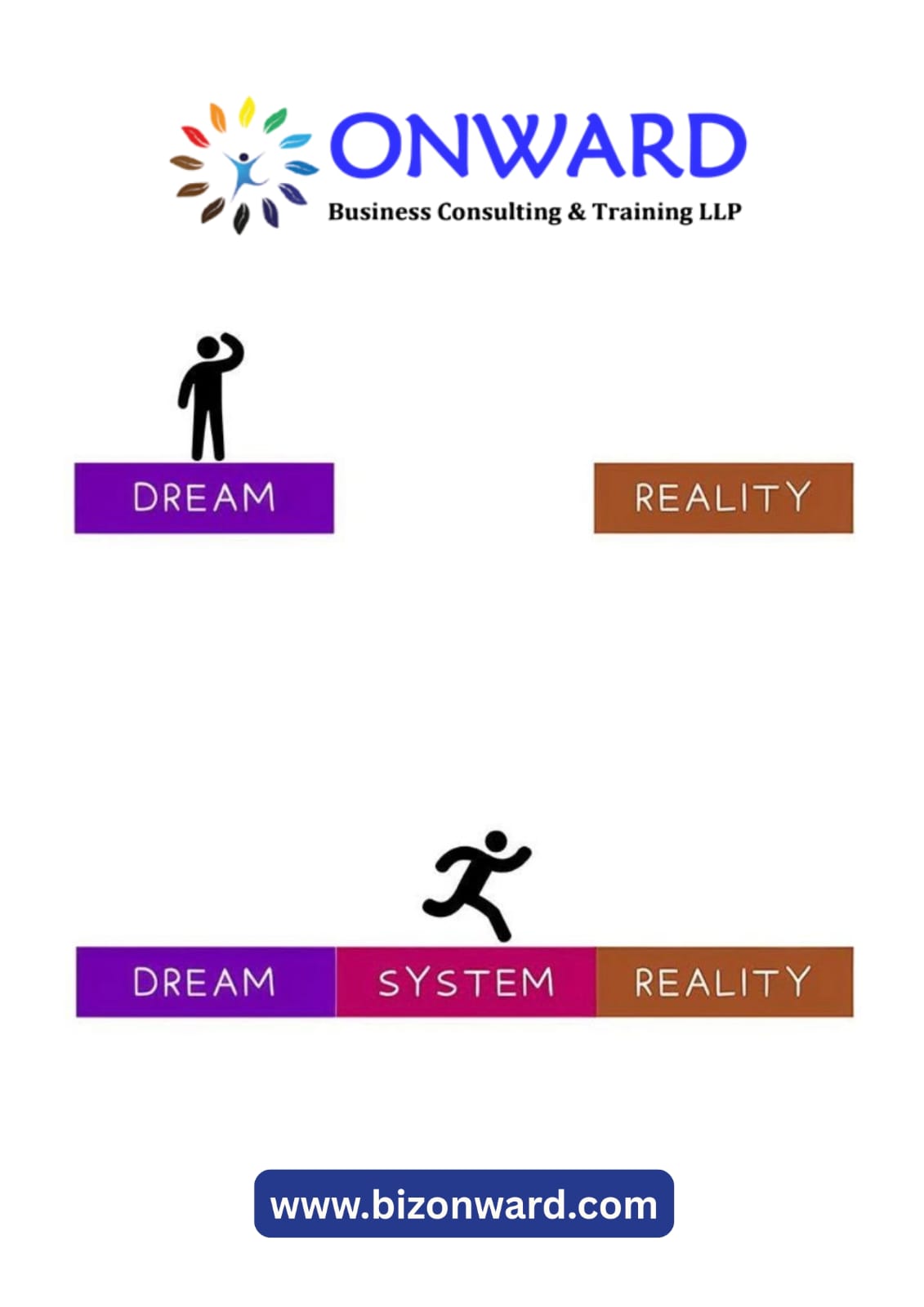
Every ambitious goal begins as a dream. Whether it is business growth, career advancement, or personal transformation, the vision is usually clear and inspiring. Yet, for most people and organizations, that dream remains distant. The gap between aspiration and outcome is not effort or intent, it is the absence of systems.
Dreams rely on motivation. Reality depends on execution. Motivation is temporary; systems are structural. A system converts intention into repeatable action. It defines how work flows, who is responsible, what gets measured, and how progress is reviewed. Without this bridge, even the strongest vision collapses under inconsistency.
Many failures are not due to lack of talent or resources, but due to unstructured processes. People work hard, but not in alignment. Decisions are reactive instead of deliberate. Progress feels busy, yet outcomes remain unchanged. Systems eliminate this friction by creating clarity and predictability.
A well-designed system does three things. First, it simplifies complexity by breaking goals into manageable steps. Second, it ensures continuity, results do not depend on individual moods or heroics. Third, it enables scale, allowing growth without chaos.
Reality is not achieved in one leap. It is reached by consistent movement across a stable path. Systems provide that path. They turn ambition into discipline and vision into results.
Dreams define direction. Systems define movement. Reality is achieved when both work together.